
This reflection explores the possibility of welcoming a love that is genuine and sincere, one that deepens through understanding and allows two people to cherish each other for who they truly are.
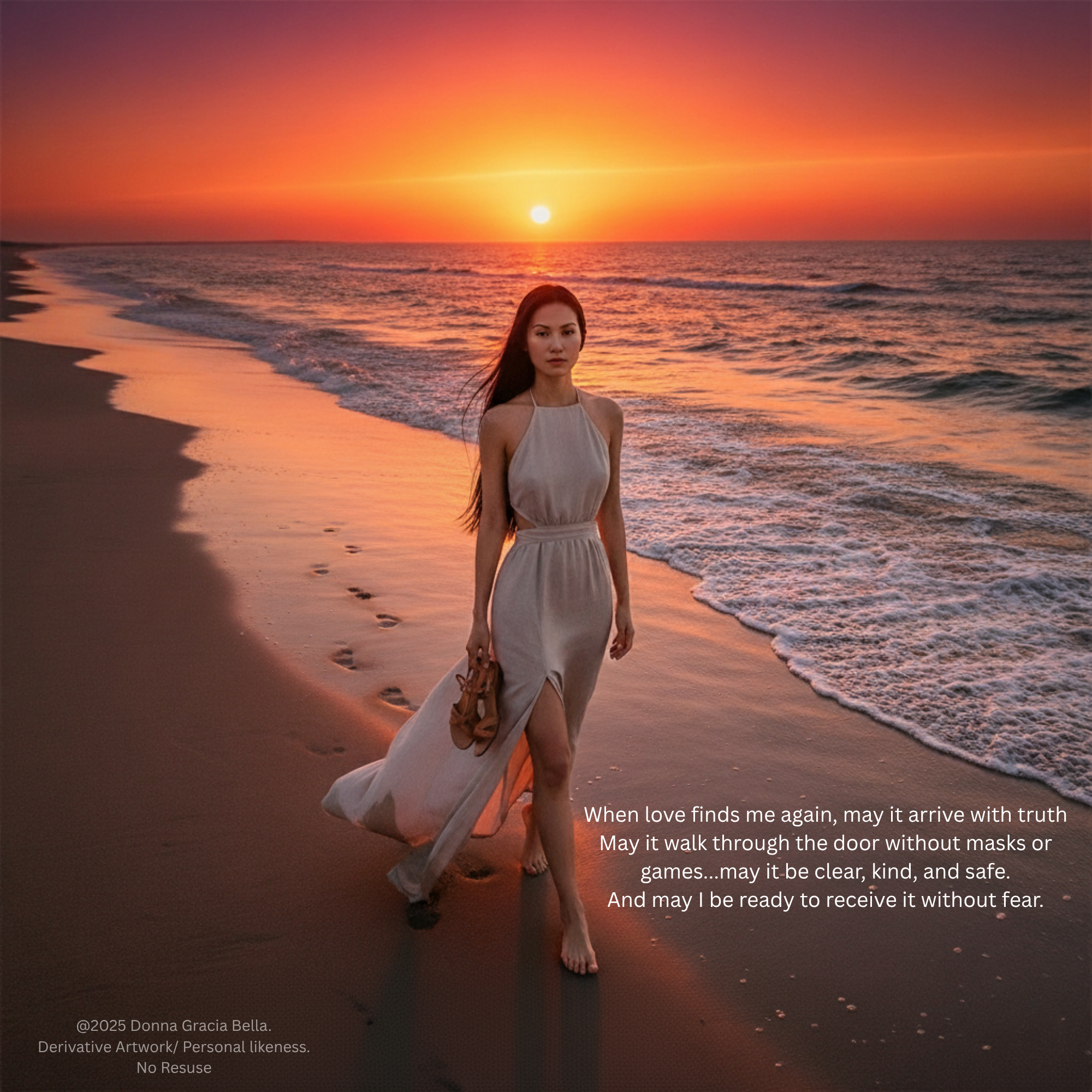
When love finds me again, may it arrive with truth.
May it walk through the door without masks or games.
This time, I open my heart to love and healing.
May it bring calm to my spirit, not confusion to my mind.
May it show up fully, not halfway, not someday, not almost.
I no longer want to guess how someone feels,
or fight for crumbs, or beg to matter.
I will not hold love that disappears when it’s inconvenient,
or trust promises that fade when they’re most needed.
This time, I want love that holds steady:
that listens without defense, that speaks without silence,
that stands present without needing to be chased.
I wish to be seen in both light and shadow,
chosen, not compared; loved for my essence, not my effort.
A love that honors strength without fearing softness,
respects space yet still reaches for connection.
I deserve love that feels like peace:
not perfection but presence, not fantasy but truth,
not control but connection.
When love returns, may it be clear, kind, and safe.
And may I be ready to receive it without fear.
This reflection reminds me that love and healing
begin not in another’s arms but in returning to my own truth.
© Donna Gracia Bella, All Rights Reserved.
The Possibility of You
Sometimes, in the quiet wanderings of my imagination, I see myself walking beside the sea as evening gathers over the water. The last light rests upon the horizon, and the waves come ashore with the gentle persistence of things that have never needed to understand time. I am alone in this imagined place, yet the solitude is beautiful. Nothing is missing from the evening. Still, as I watch the distant waters disappear into the sky, a question rises within me, tender and strangely familiar.
I wonder where you are.
It is a curious thing to wonder about someone whose face I cannot describe, whose name I have never spoken, whose footsteps may never cross the path of my own. Perhaps you are somewhere beneath the same evening, occupied with the ordinary concerns of a life I know nothing about. You may be watching the rain from a distant window, turning the pages of a book, or listening to a song whose meaning belongs entirely to you. The world is vast enough to conceal a thousand possibilities in a single hour. And among them, I sometimes allow myself the beautiful uncertainty of imagining you.
There are stories I have encountered in books and films that linger long after their endings, not because I wish to inhabit the lives of their characters, but because they awaken a question that seems older than the story itself. What is it that makes one presence unlike any other? Why should a stranger sometimes feel strangely known, while another, whose face has become familiar through countless encounters, remains beyond the reach of our deepest understanding?
I have wondered whether recognition always begins with memory. We remember people through their features, the sound of their voices, the particular manner in which they laugh or speak our names. Yet the imagination sometimes ventures beyond these earthly ways of knowing. It asks whether something in us could recognize what the eyes have never seen, whether a bond might possess a significance that cannot be measured by the length of an acquaintance.
I do not pretend to know the answer. Perhaps such thoughts belong to the mystery of consciousness itself, to that immeasurable region of being where our understanding grows quiet before questions too immense to settle. But I find beauty in contemplating them. The thought that existence may contain meanings we have not yet learned to perceive does not make the present world less real or precious to me. It makes its ordinary moments seem capable of holding an unexpected wonder. What if a meeting is not always the beginning of a connection? What if, in some mystery beyond our knowing, the visible encounter is merely the first occasion upon which something inward finds its way into expression?
I imagine the possibility of hearing a voice for the first time and feeling an inexplicable stillness, as though the world has briefly withdrawn its noise to make room for something I cannot name. Or the encounter might be so unremarkable that only later would I understand its significance. There might be no extraordinary sign, no sudden certainty. Just words exchanged between two people, followed by the faint impression that a conversation has opened somewhere beyond the limits of what was spoken.
And if such a moment ever comes, I hope I will have the grace to let it remain a beginning. For however beautiful recognition may feel, it cannot reveal an entire human being in an instant. There will be thoughts behind your words that I have yet to understand, sorrows I have no right to presume, dreams that took shape long before my existence entered your awareness. I would want to discover these things as they are given, without rushing to make you resemble the figure my imagination may have fashioned. There is tenderness in allowing another person to be unknown.
I think of all the lives we pass without ever entering, the countless stories unfolding behind illuminated windows, in distant cities, along roads we may never travel. Each life contains a world that is complete in its own complexity. And should yours one day draw near to mine, I would not wish to diminish that world by believing I had understood it simply because something within me stirred at your arrival. The mystery would deserve greater patience than that.
When Appearance Gives Way to Truth
I have come to think that what resembles love is not always love itself. There are ways of speaking that can imitate tenderness, gestures that borrow the appearance of devotion, and promises so beautifully offered that, for a moment, they seem to possess the substance of what they describe.
Words can be enchanting. A person may speak of eternity with such conviction that even the passing hour appears willing to believe. Yet eternity is an immense promise to place upon a human tongue. I would rather hear a simple truth, imperfectly spoken, than be offered a beautiful certainty that cannot survive the demands of an ordinary day. This is why I return so often to the thought of a love without masks.
A mask need not be cruel to be misleading. Sometimes it is fashioned from the wish to be admired, from the fear of disappointing another, or from the quiet temptation to become whatever someone hopes to find. We may conceal our uncertainties behind eloquence, our limitations behind promises, our genuine selves beneath an image carefully arranged for acceptance. The disguise may be lovely. It may even be worn without deliberate harm. Yet what can be cherished between two people if the very thing being cherished has never been allowed to appear?
I wonder how much beauty is lost when we are afraid to arrive as we are. I would want to know the person behind the carefully chosen words. The one who speaks without rehearsing every feeling, who can admit uncertainty without treating it as defeat, who has the courage to say what is true even when a more pleasing answer lies within easy reach. I would want our conversations to contain the freedom of ordinary honesty, where neither person must continuously perform the extraordinary merely to remain beloved. And I would wish to offer that same freedom.
How tender it would be to say, This is what I feel, without embellishing it into something grander. There is dignity in admitting, I do not know, when the answer has not yet arrived. Such moments may appear too modest for the language of great romance, but I suspect they hold a beauty more difficult to counterfeit. For what is the value of an extraordinary declaration if the smallest truth must struggle to be heard?
I imagine two people sitting together after the day’s conversations have exhausted themselves. Nothing remarkable remains to be said. Perhaps one is reading while the other watches the evening deepen beyond the window. Their nearness asks for no performance. Neither must manufacture a charming word to fill the pause. The unspoken has become peaceful because so much of what matters can already be trusted. How beautiful it would be to share such an ordinary hour.
Yet I would not confuse peace with the absence of disagreement, nor would I expect another person to possess an endless capacity for tenderness. We bring our human limitations wherever we go. There will be fatigue, differences of understanding, moments when the right words arrive too late. A love worth contemplating cannot be so fragile that it dissolves at the first encounter with imperfection.
What matters is what two people do with those moments. An apology offered without being forced can carry more devotion than a hundred declarations. The willingness to return to a difficult conversation may reveal more about one’s heart than the ease of speaking beautifully when everything is well. Even the simple courage to acknowledge another person’s pain without making a spectacle of one’s own intentions can become an act of uncommon tenderness.
These are quiet things. They do not always lend themselves to poetry. Yet perhaps poetry has overlooked them only because it has so often sought love in its most dazzling moments. I would want to know the love that remains recognizable when the language becomes simple.
The kind that does not require me to search endlessly for hidden meanings in another person’s regard. The kind whose promises have enough humility to be honored. The kind in which silence may be restful rather than bewildering, because the affection beneath it has never been made deliberately uncertain. There is no beauty, to me, in continually wondering whether I matter to someone who claims to care.
I do not ask for an existence untouched by distance, obligation, or change. Life will never arrange every circumstance to suit the wishes of two hearts. There may be hours when we cannot speak, seasons when responsibilities ask more of us than we imagined, and difficult choices that neither tenderness nor longing can make disappear.
But absence and indifference are not the same thing. One can be occupied and remain considerate. One can need solitude without withdrawing affection as a punishment. One can be far away and still offer the quiet reassurance of a love that has learned to be truthful.
To be present does not always mean to stand within reach of another’s hand. Sometimes it means remembering the promise one has made, even when no one is there to witness its keeping.
Where Distance Cannot Reach
I think of two lives unfolding beneath different skies, and how little the miles between them can tell us of what they may come to mean to each other.
We speak of separation as though the miles themselves possessed the power to determine how deeply one life may touch another. We measure journeys by oceans crossed, roads traveled, the hours between departure and arrival. And certainly the body knows distance. It understands the absence of an embrace, the empty place beside us, the longing to share an ordinary moment without a screen or a journey standing between.
Yet there is another kind of nearness that seems strangely indifferent to geography. A few words from someone far away may enter the heart more deeply than conversations shared across the same table. A presence can become meaningful before the familiar world has given it a place to stand. Someone may be a thousand miles beyond our reach, and still we find ourselves carrying the warmth of a conversation into the smallest activities of the day.
Perhaps this is why the spiritual imagination has always been drawn toward the mystery of apparent separation. If we are more than the passing forms through which we know ourselves, if consciousness holds depths that cannot be reduced to the body’s boundaries, what might that suggest about the nature of connection? Could the deepest intimacy be something other than the nearness of two forms in space?
Such questions do not surrender their answers easily. I would not claim to possess knowledge of what lies beyond this life, nor would I mistake a beautiful possibility for a certainty owed to me by the universe. Still, I find myself returning to the thought that what is most meaningful between two beings may not be contained entirely within the visible circumstances of their meeting.
Sometimes I imagine existence as an immense unfolding in which every life appears for a little while beneath its own name. We enter the world wearing the particular features of our time, learning its languages, inhabiting its customs, gathering memories that will one day belong to history. Our faces change even within a single lifetime. The voice grows older. The hands that once reached eagerly toward the world begin, in time, to carry the delicate evidence of all they have touched. And yet, somewhere within that changing life, we continue to ask who it is that experiences these transformations.
When I contemplate love through this mystery, the question becomes wonderfully different. I no longer think merely of whether two people might find each other in another age. I wonder what there could be to recognize when everything by which they were once identified has fallen away.
Would recognition require the same eyes, the same language, the same beloved face? Or could the imagination conceive of a deeper familiarity, one that does not depend upon the outward particulars through which affection first became known? I cannot say. But the possibility has a strange tenderness that ordinary explanations seldom reach.
Perhaps what we call a first encounter would not, within such a vision of existence, be the first movement of the heart toward another. Perhaps time belongs to the unfolding of the story, while the deepest meaning of the encounter remains beyond the pages on which that story is written. It is a thought I hold gently, without asking it to prove itself.
For there is danger in allowing an imagined eternity to excuse the neglect of a present life. A feeling of profound recognition cannot tell us whether another person is sincere, whether affection is mutual, or whether two lives can flourish together. Whatever mystery may draw us toward another, we still meet here, in this world, where words have consequences and promises must be lived.
If someone should feel impossibly familiar to me, I would still want to know how he treats the lives entrusted to his care, how he speaks when disappointed, whether kindness remains when admiration is no longer easy. I would want the enchantment of recognition to deepen through discovery, rather than be defended against everything discovery might reveal. For surely a connection worthy of such spiritual wonder should have no need to fear the truth.
And perhaps there is something quietly beautiful in imagining that the extraordinary and the ordinary need not compete. A meeting may awaken questions about eternity while a single thoughtful gesture brings its meaning into the present. The infinite may remain a mystery, but the tenderness of two human beings is something they can choose to make real.
The world may give them a date upon which they first met. Their families may remember a ceremony, a gathering, the exchange of vows. These moments deserve their own reverence. Yet I can imagine a bond whose meaning is felt long before it is spoken publicly, and whose significance cannot be measured merely by the day on which a promise acquired its outward form.
Even so, no ceremony and no spiritual conviction can take the place of the freedom with which two people continually choose to honor one another. There is a rare beauty in that freedom. It allows a connection to be both mysterious and accountable, inwardly profound and outwardly sincere.
If Love Should Find Its Way
I wonder sometimes whether I will recognize such a love immediately, or whether its significance will arrive so gradually that I will only understand it after many ordinary moments have passed. Perhaps it will begin with conversation, with the unexpected ease of speaking about things that matter, with the discovery that another person can enter the landscape of my thoughts without disturbing the peace I have made within myself.
Or it may begin with uncertainty, the gentle hesitation of not yet knowing whether the feeling I sense belongs to something lasting or merely to the loveliness of possibility. I would allow myself that hesitation.
A heart can be open without handing its entire future to the first person who awakens its wonder. It can cherish a beautiful encounter while permitting time to disclose its meaning. There is no need to rush the unfolding of something precious, nor to force certainty upon what has only just begun.
I think of the flower that opens without being commanded by the morning. No hand can persuade its petals to reveal themselves before their hour, and no impatience can make its fragrance more beautiful. Its unfolding belongs to a rhythm that cannot be hurried without injury. Perhaps the beginnings of love deserve a similar gentleness.
I would want to discover what it is to know someone without losing the delight of discovery. To hear a familiar voice and still find something unexpected in its cadence. To learn the little details that no grand declaration could reveal: what brings another person laughter, what moves him to quiet reflection, what matters deeply enough that he will protect it even when no one is watching. I would want us to be capable of wonder without becoming strangers to reality.
And if an affection of unusual depth should one day become part of my life, I hope it would enlarge the beauty of what is already here. There are books still waiting to be read, thoughts still asking to be written, mornings whose quiet belongs wholly to themselves. A meaningful companionship should not demand that the inward life be abandoned at its arrival. How much more beautiful if each person brought an inhabited world to the meeting, and found that love made both worlds more spacious.
Perhaps we would learn that intimacy is not the disappearance of two distinct beings into a single desire. It is the extraordinary permission to remain fully ourselves while discovering how deeply our lives may touch. The thought moves me because it asks for a love without captivity. Whatever spiritual mystery may surround a meeting, neither person becomes the possession of the other. Each remains a living consciousness, worthy of honesty, tenderness, and freedom.
And there is something equally moving in the knowledge that we cannot promise another person immunity from sorrow, change, or the impermanence of earthly things. Even the most cherished companionship lives within a world that is continually passing. Its beauty is not secured by pretending otherwise. Perhaps this is where the longing for eternity becomes most human.
We look upon what is beautiful and wish, almost instinctively, that it might be spared the passage of time. A voice we love, an unexpected kindness, an evening whose happiness seems too delicate to disturb: how naturally we wish to preserve them. Yet it may be the knowledge of their fragility that teaches us to receive them with greater attention.
If love is ever to enter my life in the way I imagine, I would not ask it to abolish the mystery of existence. I would ask only that what we share be genuine while it is ours to live. Let whatever is offered be freely given, whatever is promised be sincerely intended, and whatever remains unknown be approached with patience rather than disguise.
There may be no such meeting. I can allow for that possibility without bitterness. A beautiful imagined future does not make the present unworthy, just as an unanswered question does not diminish the life in which it is asked. Still, I will not close my heart against the possibility of something extraordinary merely because its arrival cannot be assured.
Somewhere, perhaps, another life is unfolding beneath a sky I have never seen. Its path may never touch mine. Our stories may cross for a moment, or grow into something neither of us could have imagined beforehand. I leave the answer to the unfolding of time.
What I carry within me is simpler, and in some ways more demanding, than the hope of an enchanted encounter. If love should find its way into my life, I want to be able to welcome the wonder without losing sight of the person who stands before me. I want to hear the words, observe the deeds, and discover whether their meanings belong together. I want a connection beautiful enough to inspire imagination, yet truthful enough to need no illusion for its survival.
And should the day come when a once-unknown voice becomes familiar, when the distance between two lives grows smaller through affection and understanding, I hope there will be no need to ask either heart to become someone else in order to remain.
Perhaps then I will understand why the thought of such a meeting has sometimes moved me even in its absence. Or perhaps the mystery will remain, and we will simply be grateful for the beauty that has found its way into the ordinary world.
Either way, I would want to meet it with an open heart, a quiet mind, and the freedom to recognize what is real.
© Donna Gracia Bella, All Rights Reserved.
If this reflection speaks to you, you’re welcome to send me a quiet note through the Contact page.